

In agricultural farm management, livestock housing, and property boundary zoning, selecting appropriate mesh materials directly impacts structural longevity, ongoing maintenance, and daily operational safety. For decades, galvanized welded wire mesh and woven hardware cloth have served as familiar physical barriers across farms, poultry runs, and garden enclosures. In recent years, extruded high-density polyethylene square netting has emerged as an alternative material for specific agricultural enclosures. Choosing between extruded polymer mesh and metallic wire cloth requires an objective assessment of material characteristics, environmental exposure factors, structural limitations, and specific farm requirements.
The primary structural difference between these two material categories stems from their respective manufacturing methods. Galvanized hardware cloth is produced from drawn carbon steel wire that is subsequently welded or woven into a grid pattern and treated with a protective zinc layer. In contrast, extruded HDPE square netting is formed through continuous thermal melt extrusion of high-density polyethylene resin. The molten polymer passes through specialized tooling to create a continuous grid where vertical and horizontal strands join into solid integral nodes. Because extruded polymer netting lacks mechanical weaves or welded wire joints, the cut edges along trimmed rolls do not unravel or fray when adapted to custom frame dimensions during on-site installation.
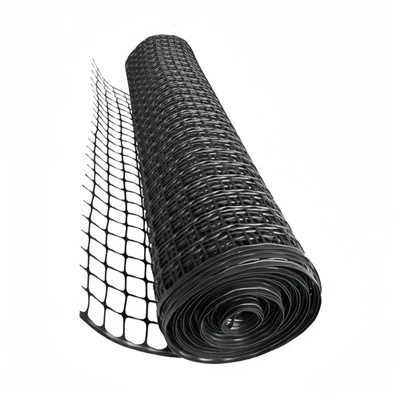
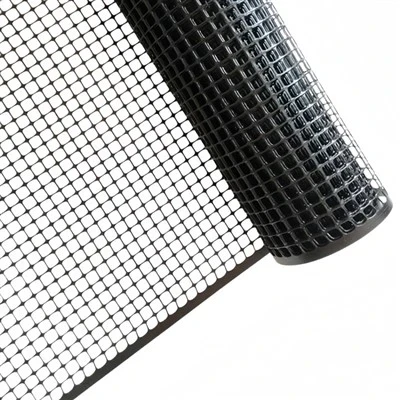
High-density polyethylene extruded square netting featuring integral solid junctions for agricultural barrier fencing.
[Suggested ALT Text: Black extruded HDPE plastic square netting with smooth monolithic solid joints for poultry farm fencing]
Chemical Resistance and Environmental Exposure Factors
Farm enclosures frequently encounter demanding environmental conditions involving moisture, soil contact, and animal waste exposure. Galvanized steel wire mesh provides reliable structural rigidity and proven performance in dry, well-ventilated farm installations where zinc coatings effectively shield the underlying steel from atmospheric oxidation. However, in enclosed poultry housing or damp ground contact areas, prolonged exposure to moisture and decomposing animal manure can gradually deplete the protective zinc layer. Once the zinc barrier degrades, underlying carbon steel becomes vulnerable to surface corrosion over extended timeframes.
High-density polyethylene exhibits inherent resistance to moisture, mild organic acids, and common agricultural residues. Because the polymer matrix is non-porous and non-metallic, it does not rust or corrode when placed in damp soil zones or exposed to routine agricultural washdown. This chemical stability makes extruded plastic square mesh particularly practical for perimeter partitions adjacent to manure accumulation zones, compost boundaries, and high-humidity garden beds where metallic wire often requires periodic surface inspection and replacement.
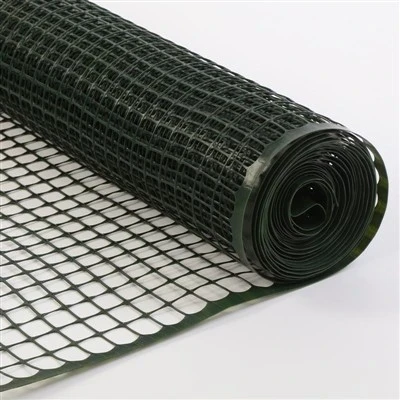
Durable green plastic square mesh designed for agricultural enclosures and garden perimeter demarcation.
[Suggested ALT Text: Green extruded plastic square mesh roll for agricultural boundary and garden perimeter fencing]
Surface Characteristics and Animal Contact Considerations
When enclosing poultry pens, flight cages, or farm boundaries, physical interaction between animals and barrier surfaces represents an important operational consideration. Traditional galvanized wire mesh offers sturdy containment, but cut wire ends along trimmed edges can leave stiff, sharp metallic points. If livestock or birds repeatedly brush against these exposed wire ends along lower pen perimeters, surface contact may cause superficial scratches or skin abrasions, requiring careful installation detailing and edge folding to minimize physical hazards.
Extruded HDPE square netting features smooth, rounded polymer strands with clean intersection nodes that lack sharp metallic burrs. When trimmed to length using standard utility snips, the resulting plastic edges remain relatively pliable and smooth, reducing the risk of accidental contact scratches during routine flock handling. While plastic mesh provides a non-abrasive vertical barrier for chicken runs, brooding pen walls, and garden partitions, standard square netting is designed primarily as a vertical or spatial boundary and is not engineered to serve as heavy load-bearing flooring or permanent manure drop grating.
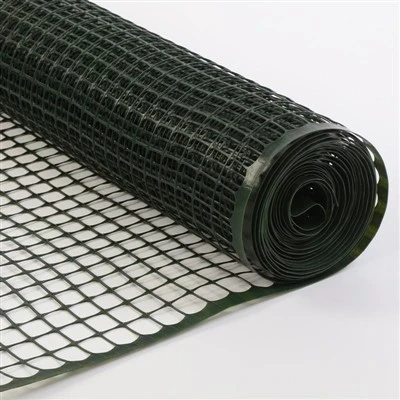
Rigid extruded square plastic fencing installed as a protective barrier in farm and garden boundary applications.
[Suggested ALT Text: Rigid black square plastic mesh fencing for farm zoning and internal animal pen partitioning]
Aperture Dimensions and Practical Agricultural Applications
Selecting appropriate mesh specifications depends on target livestock size, installation orientation, and airflow requirements. Extruded HDPE square netting is commonly produced in medium-to-heavy areal weights between two hundred seventy and three hundred grams per square meter. This grammage level provides sufficient semi-rigid body to hold shape across fence posts without excessive sag, serving as a lightweight barrier rather than a heavy structural containment wall.
Aperture dimensions generally follow functional sizing categories for specific farm zones. A nominal ten-millimeter square opening, measuring approximately three-eighths of an inch, is widely utilized for small chick brooder partitions, light garden screening, and perimeter debris interception. A twenty-millimeter square opening, approximating three-quarters of an inch, serves effectively for chicken run walls, aviary side partitions, and poultry exercise yards. Larger apertures, such as twenty-five-millimeter and forty-millimeter configurations, provide economical options for temporary pasture zoning, vegetable garden support trellises, and internal livestock area demarcation where maximum air movement and visibility are desirable. Commercial buyers should note that plastic mesh is not designed to stop aggressive burrowing rodents, rats, or predatory animals capable of chewing through synthetic polymers.
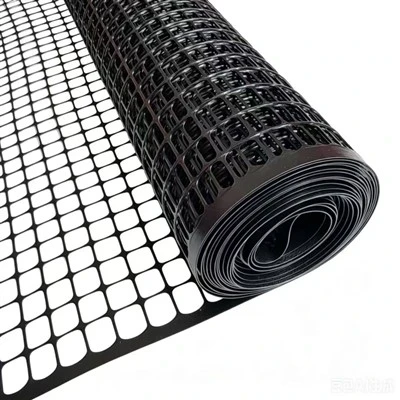
Heavy-duty extruded plastic square netting providing structural containment and ventilation across agricultural facilities.
[Suggested ALT Text: Heavy duty extruded black plastic square netting roll sample showing uniform grid structure]
Material Selection Criteria and Farm Zone Matching
An objective procurement decision requires matching specific operational requirements with the appropriate material strengths. Galvanized steel wire mesh remains the preferred engineering choice where high structural rigidity, physical load-bearing support, and resistance to rodent chewing or heavy animal impact are paramount. Perimeter enclosures exposed to severe predatory pressure or structural framing roles generally benefit from the mechanical strength of steel wire cloth.
Extruded HDPE square netting offers distinct advantages where rust immunity, ease of handling, rapid on-site cutting, and non-conductive properties are primary priorities. It is well suited for internal pen divisions, poultry exercise enclosures, horticulture trellising, and damp outdoor borders where metallic corrosion presents ongoing maintenance burdens. By recognizing the practical strengths and operational boundaries of both materials, agricultural buyers can select the most cost-effective and functional solution for each specific farm zone.
Extruded plastic square mesh rolls packaged for agricultural distribution and commercial farm installation.
[Suggested ALT Text: Green plastic square mesh roll for horticulture support and commercial farm distribution]
Manufacturing Specifications and Sourcing Guidelines
Shaoxing Yongte Plastics supplies virgin high-density polyethylene square netting in standard commercial roll widths of one meter and one point twenty-two meters, with continuous roll lengths ranging from fifteen to fifty meters. To support multi-season outdoor exposure across varied regional climates, optional hindered amine light stabilizer additives can be compounded into the polymer formulation to mitigate ultraviolet weathering degradation.
When requesting technical quotations, agricultural distributors and fencing contractors are encouraged to specify required polymer grade, mesh aperture dimensions, roll weight in grams per square meter, and customized private-label packaging requirements. Commercial buyers seeking physical mesh swatches, comprehensive specification sheets, or export container loading estimates are welcome to contact our technical sales and engineering department.